E-mail: kontakt@waterflex.pl
Waterflex ul. Wrocławska 130, 58-306 Wałbrzych

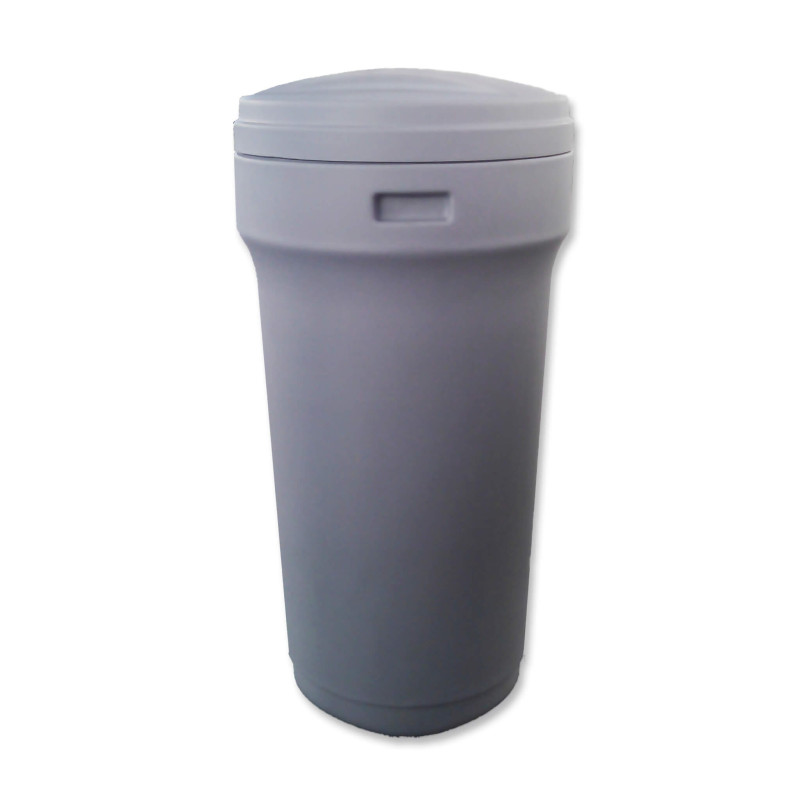
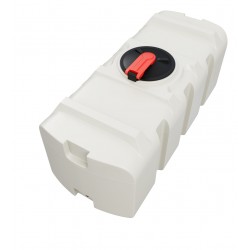
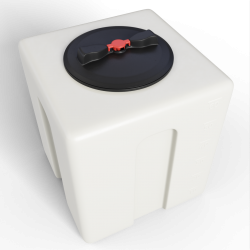
A special plastic container designed for the preparation and delivery of the sodium chloride solution
(NaCL) in softening installations, stations of complex (simultaneous) iron removal and softening and
in water demineralization systems. The salt tank is an integral part of almost every filter design
hopper, where the filter media are based on ion-exchange resins, which require rinsing of the material
sodium chloride solution to restore its ion-exchange properties.
The container has a Polish hygienic certificate of the National Institute of Hygiene, which entitles it to contact with drinking water.
Characteristics
Volume: 75 l
Length: 40.3 cm
Width: 40.3 cm
Height: 80.9 cm
Wall thickness: 4mm
Material:
- High quality polyethylene
- With high strength
- Resistant to frost (-40°C to +60°C)
- Possibility of storing food products
- Resistant to UV radiation
- O wysokiej wytrzymałości
- Odporny na mróz (-40°C do +60°C)
- Możliwość magazynowania produktów spożywczych
- Odporny na promieniowanie UV
Description
1. Purpose of the products
The containers are made of virgin polyethylene in accordance with TU U 25.2-33458437-003:
2007 POLYETHYLENE CONTAINERS.
The containers are reusable, used for STATIONARY
storage of liquid and loose products (including food and drinking water).
Polyethylene is resistant to UV radiation.
V60, V130, V200 containers have a tight lid, so they can be used
additionally used to transport liquid and loose products. Transportation only in
vertical position, without stacking, while the transport speed should not
exceed 60 km/h. When transporting partially filled containers
it is necessary to reduce speed on bends, ascents and descents.
ATTENTION!!! Tanks can be operated at temperatures from -30oС to +60oС,
if the temperature acting on them does not lead to chemical or physical damage
interaction of the stored substances with the material of the container, which may lead to
to destroy the container or change the chemical composition of the substance (e.g. destruction
container as a result of freezing of the substance, unsealing of the container, evaporation
liquids, etc.). These cases are not covered by the Manufacturer's Warranty.
Tanks are not designed to be installed in the ground.
2. Storage, loading, transport.
Tanks should be stored in the temperature range from -30oC to +60oC
flat, compact ground with an area that ensures its stable position. Conditions
storage should exclude the penetration of aggressive substances into the surface
tanks and the ingress of moisture inside the products. In the case of long-term
direct sunlight should be excluded during storage
products. The loading and unloading operation takes place with empty containers,
manually or with a forklift. The transport of empty containers is allowed
any type of transport with the required load capacity and dimensions of the platform
loading. The transport position of the tank must be agreed with the Manufacturer.
Tanks must be secured, excluding the possibility of their movement
during the transport.
3. Installation and connection.
The tank should be installed on the flat surface that is intended
to the appropriate load (weight of the filled container). Deviations from the coating
horizontal in the longitudinal and transverse directions - not more than 3 mm per meter of length.
Permitted depressions and protuberances not exceeding 3 mm. Container
must be carefully inspected for defects before starting work
affect its operation. In case of detecting them, the Manufacturer should be informed
to eliminate defects. When installing on the foundation, check for correct
the location of the liquid inlet and outlet. When using V60, V130, V200 tanks to
when transported by road, it is necessary to fasten it
the tank with straps (not included in the delivery set) and ensure
stops that prevent the tank from shifting during movement.
The restrictors must be in contact with the tank through the damping pads which
prevent tank damage.
4. Use of containers in operation.
Before using the container for the first time, as well as after repeated use, the container
should be washed with a solution of baking soda with the addition of any detergent
disinfectant, then rinse with water. After the procedure - drain the water. All
the elements of the tank, including the cover, are not a load-bearing structure, therefore during
operation, it is forbidden to apply additional forces to the product
Attachments
You might also like
Products in the same category